Report on online Spotlight on Austronesian Cultures: General discussion
Islands of Good Governance: Indigenous Knowledge and Community Development in the Contemporary Pacific
🟤 general discussion retrospect
Summary: Naomi
The general discussion wrapped up the Islands of Good Governance: Indigenous Knowledge and Community Development in the Contemporary Pacific Youth Forum. This discussion was moderated by Assistant Professor Yayut Yi-Shiuan Chen of the Master’s Program of Land Policy and Environmental Planning for Indigenous Peoples at National Chengchi University (NCCU). The first discussant was Associate Professor Nga-Ping Ong at the Department of Ethnology at NCCU. Professor Ong discussed the history research in Southeast Asia began in Taiwan around 1994, while NCCU began doing such research in 2008. She highlighted that in 2018, the Center for Taiwan-Philippines, Indigenous Knowledge, Local Knowledge and Sustainable Studies was created. Led by Professor Kuan Da-Wei, the center brought students and staff to participate in site visits across Taiwan and the Philippines. She noted her anticipation for the youth forum, encouraging young scholars to participate in dialogue across the pacific region.
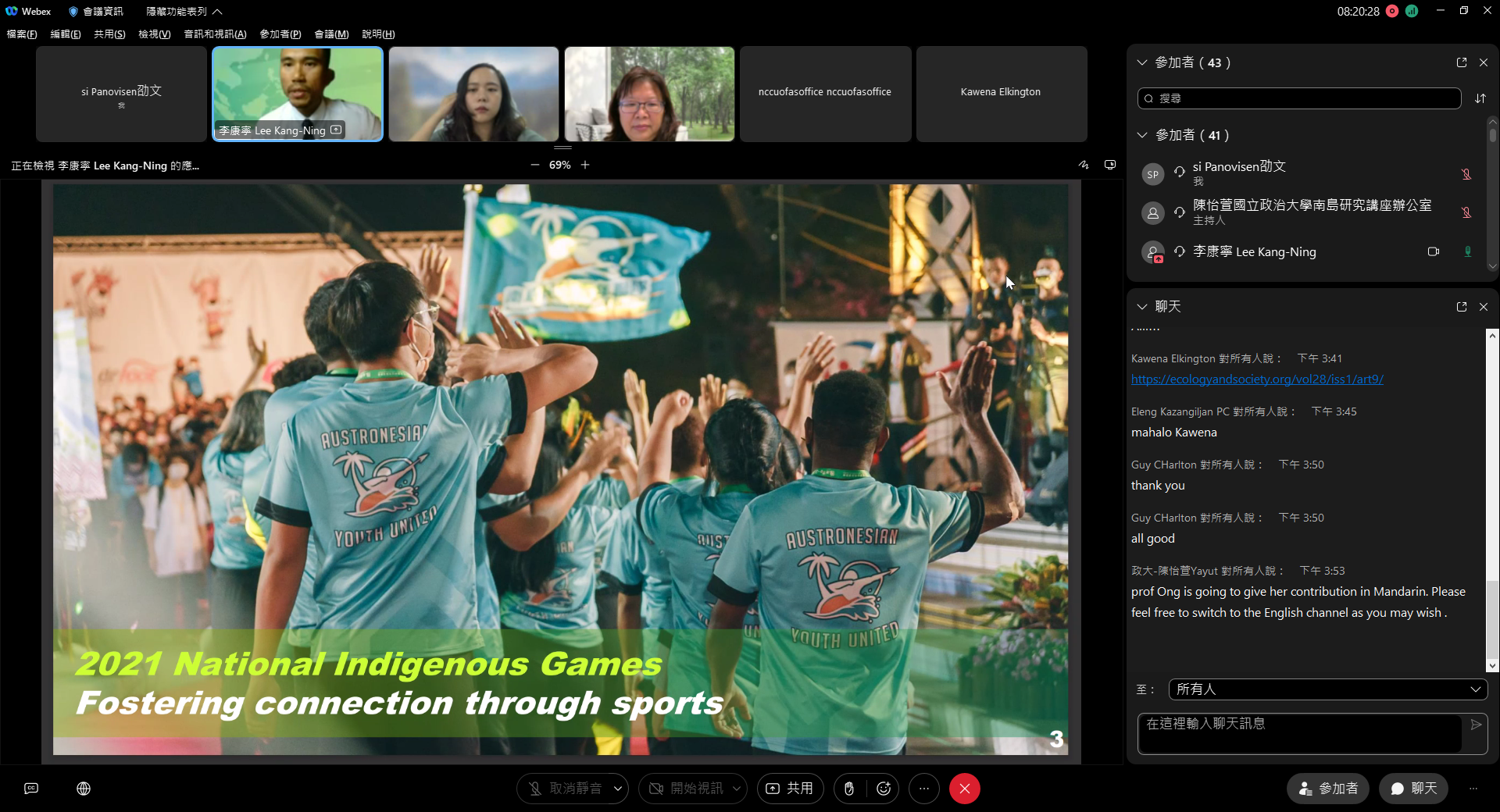
The second discussant was Mr. Kang-Ning Lee—Kacaw is his Amis tribal name—Section Chief of International Affairs at the Council of Indigenous Peoples (CIP). Section Chief Lee started his talk by stating how sports is a way to bring people together within and across countries. In turn, Taiwan began hosting the National Indigenous Games. Most recently in April 2023, the CIP invited a Aotearoa New Zealand Maori team to participate in the Games. Then, he gave some background information regarding CIP and noted this agency was created following the Indigenous Rights Movements which started in 1984. Given the influence of the United Nations Declaration on the Rights of Indigenous Peoples on Taiwan’s Indigenous Peoples Basic Law, he highlighted the imperative work of cooperation across the Austronesian Region. Taiwan is the homeland of the Austronesian language family, the largest language family in the world consisting of over 1200 languages. In turn in 2019, the CIP adopted a 6 year plan of Austronesian forums to continue fostering cooperation across the Austronesian regions. Amongst the various works this entity does, he noted the annual International Indigenous Youth Forum which took place most recently in March. It was held in Guam and they invited 24 youth from across the Pacific to learn about Chamoru culture. Here is the video of the forum he shared: https://youtu.be/0pnvms1bl7o
Following Section Chief Lee’s presentation, the discussants were asked to speak about their anticipation regarding the future collaboration between the academic sector and practitioners. Mr. Lee discussed how CIP has a sector under the 6 year plan dedicated to academic research through providing funding to studies on Austronesian histories, migration, decolonization and more. He believes the 6 year plan is just a starting point for such collaboration.
Professor Ong discussed how youth today have many more opportunities to do research and make connections across the pacific regions. She believes youth forums are a great method and allows for the dissemination of the most recent research outcomes while enabling youth researchers to have a platform to share their research. She believes this work across the Austronesian region resembles research on the Tayal tribe, which consists of 3 generations of people working on it spanning over 30 years.
Professor Chen ended the discussion by recapping the key points of the discussants that this work takes continuous effort and cooperation between generations of scholars and practitioners. She acknowledges Austronsiesian studies is promising currently in the national and international context. Further, she echoes the keynote speaker Professor Yuan-Chao Tung, saying that as we continue this work, it’s important to not forget that the diaspora of Austronesian people is not homogenous. Noting this difference is important, then we must come together and create relations across sectors.